AI Article SummaryGenerated from this article's content
High Confidence
Key takeaways:
Chemical engineering suits students strong in maths and physics; pharmacy suits those with a biology focus.
Gujarat entrance exams: GUJCET and JEE Main for engineering; GUJCET for B.Pharm admissions.
Starting salaries: Rs. 3-6 LPA for chemical engineers; Rs. 2-4 LPA for pharmacy graduates.
Both programmes are available at Sigma University in Vadodara.
Choosing between engineering and pharmacy after 10th comes down to whether your interests lie in industrial processes or healthcare. Both are strong careers with solid prospects in Gujarat.
Pick any science classroom in Gujarat and ask students what they’re considering after Class 12. Most have it narrowed down to engineering or pharmacy. Both chemical engineering and pharmacy are demanding professional courses. Both require a science background. But they lead to completely different careers.
One takes you into factories, refineries, and R&D labs. The other takes you into hospitals, drug companies, and government regulatory roles. This guide breaks down both options so you can make a clear, informed choice.
Quick Overview: Chemical Engineering vs Pharmacy
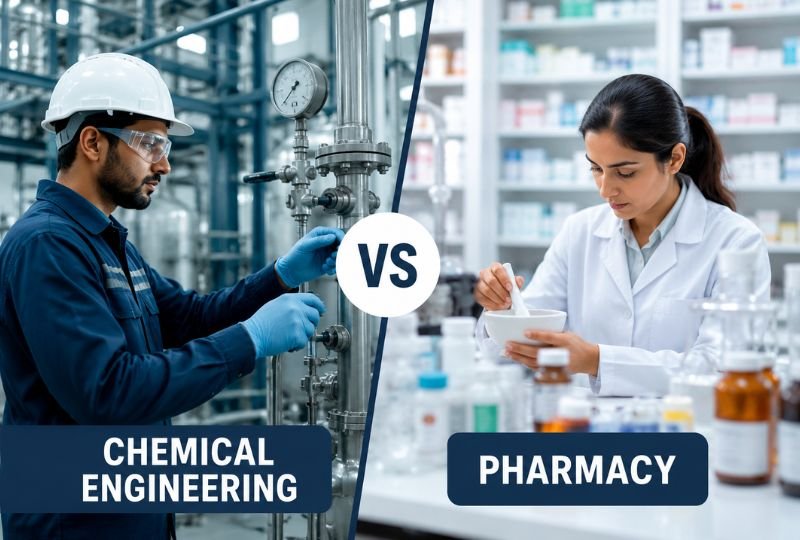
Both courses are rooted in chemistry, but engineering or pharmacy take your studies in very different directions.
What each course covers
Chemical engineering focuses on using chemical reactions to make useful products on an industrial scale. You study thermodynamics, fluid mechanics, reaction engineering, and process design. There’s a lot of physics and mathematics alongside chemistry.
Pharmacy focuses on how drugs are made, tested, and safely given to patients. You study pharmacology, biochemistry, anatomy, and drug formulation. It’s heavier on biology and life sciences than engineering.
Duration, eligibility, and top colleges in Gujarat.
Both B.Tech Chemical Engineering and B.Pharm are four-year undergraduate degrees. Engineering requires Class 12 with Physics, Chemistry, and Mathematics.
The pharmacy accepts Physics, Chemistry, and either Mathematics or Biology. Top colleges in Gujarat include Sigma University (Vadodara), L.D. College of Engineering (Ahmedabad), Nirma University, and L.M. College of Pharmacy.
Career Scope: Chemical Engineering vs Pharmacy in India
When it comes to pharmacy vs chemical engineering, both fields offer solid career scope, but in very different sectors.
Jobs after chemical engineering: process engineer, R&D, QC
Typical roles include:
Process engineer in oil, gas, or speciality chemicals.
Quality control analyst in pharmaceutical or food manufacturing.
R&D engineer in material science or green energy.
Production supervisor in large-scale chemical plants.
Jobs after pharmacy: pharmacist, drug inspector, clinical research
Pharmacy graduates typically enter:
Hospital or retail pharmacist roles
Drug inspector positions (state government)
Clinical research associate at a pharma company
Medical representative or drug regulatory specialist
Which has more government job options?
Pharmacy has the clearer edge here. A drug inspector is a well-defined state government role specifically for pharmacy graduates. Chemical engineering graduates can apply to PSUs like ONGC and BPCL, but GATE scores are essential, and competition is intense.
Fees & Admission Process in Gujarat
Gujarat has strong options for students choosing engineering or pharmacy at both government and private institutions.
Average fees comparison (private vs government colleges)
Government colleges are significantly cheaper. B.Tech Chemical Engineering at a government college in Gujarat typically costs Rs. 15,000-35,000 per year. Private colleges charge Rs. 80,000-1.5 LPA. B.Pharm fees are similar: roughly Rs. 10,000-25,000 at government colleges and Rs. 60,000-1.2 LPA at private institutions.
Ready to Shape Your Future? Apply Now.
Engineering, Design, Commerce, Law, Science & more. Join a university built for the future.
For engineering: GUJCET covers state-quota seats; JEE Main is needed for centrally-allocated seats and top private colleges. For pharmacy: GUJCET applies for B.Pharm state admissions. GPAT is the national entrance for postgraduate pharmacy programmes.
Top Gujarat colleges for both programs
Engineering: Sigma University (Vadodara), L.D. College of Engineering (Ahmedabad), Nirma University, DDIT (Nadiad), Sigma University (Vadodara). Pharmacy: L.M. College of Pharmacy (Ahmedabad), Sardar Patel College of Pharmacy (Anand).
Career goal: industry vs healthcare
Salary Comparison After Graduation
Salaries differ more by role and sector than by course alone.
Starting salary benchmarks for each field
Chemical engineering graduates entering private sector roles typically start at Rs. 3-6 LPA. PSU roles through GATE can start at Rs. 6-9 LPA with added benefits.
Pharmacy graduates typically start at Rs. 2-4 LPA in hospital or retail roles. Clinical research and regulatory roles start higher, around Rs. 4-6 LPA.
Growth trajectory: 5-year career outlook
Chemical engineers see faster salary growth in the industry. A process engineer with five years of experience commonly earns Rs. 10-15 LPA.
Pharmacy graduates in clinical research or regulatory affairs also grow well. They typically reach Rs. 8-12 LPA within five years. Government roles in both fields offer stability but slower salary progression.
Chemical Engineering VS Pharmacy Comparison
Feature
AI Powered Learning
Traditional Learning
Personalization
Customizes learning paths based on student performance
One-size-fits-all approach
Flexibility
Available anytime, anywhere via digital platforms
Fixed classroom schedules
Assessment
AI-driven instant grading and feedback
Manual grading, slower feedback
Teacher’s Role
Acts as a facilitator alongside AI tutors
Central authority in knowledge delivery
Student Engagement
Interactive simulations, gamification, and real-time analytics
Passive learning in lectures
Which Should You Choose? Factors to Consider
The right choice between engineering and pharmacy comes down to a few honest questions about yourself.
Interest in chemistry vs biology
If chemical reactions, plant operations, and process design excite you, chemical engineering is the stronger fit. If you’re drawn to how drugs work in the human body and want a career connected to healthcare, pharmacy aligns better. Interest matters more than perceived prestige.
Career goal: industry vs healthcare
Chemical engineering leads naturally into manufacturing, energy, and industrial R&D. Pharmacy leads into healthcare, pharmaceutical companies, and government regulatory work. If you’re set on working in a clinical setting or drug development lab, pharmacy is the clearer route.
Location and budget factors specific to Gujarat students
Gujarat’s pharmaceutical corridor around Ahmedabad and Vadodara creates strong demand for both disciplines. Budget-wise, engineering fees at private colleges run slightly higher than pharmacy fees. If cost is a deciding factor, speak with Sigma University’s admissions team about available scholarship support.
Engineering or Pharmacy: Making the Right Choice for Your Future
The decision between engineering and pharmacy isn’t as hard as it seems once you’re honest about your interests. Think about which subjects genuinely excited you in Class 11 and 12. That’s usually the clearest signal.
Both are well-respected professional degrees with a strong career scope in Gujarat. Sigma University offers both in Vadodara, supported by a Career Development Cell that connects graduates to 250+ recruiters and a highest placement package of Rs. 20 LPA.
FAQ
1: Which is better after 10th, chemical engineering or pharmacy?
It depends on your strengths. Chemical engineering suits students who are strong in maths and physics. Pharmacy suits those drawn to biology and healthcare. Both are strong careers with a good scope in Gujarat.
2: Can a student do both chemical engineering and pharmacy?
Not simultaneously as full-time degrees. But chemical engineers often work in pharmaceutical manufacturing, bridging both fields. Some pursue a postgraduate qualification in the other discipline later.
3: What is the scope of chemical engineering vs pharmacy in Gujarat?
Both fields have a strong demand in Gujarat. Chemical engineering graduates find roles in petrochemicals and pharma manufacturing. Pharmacy graduates work in Gujarat’s large pharmaceutical sector, especially around Ahmedabad and Vadodara.
4: Which course has a better salary, chemical engineering or pharmacy?
Chemical engineering generally starts higher: Rs. 3-6 LPA vs Rs. 2-4 LPA for pharmacy. Both can reach Rs. 10-15 LPA with five to eight years of experience in strong private sector roles.
5: What entrance exam is needed for chemical engineering in Gujarat?
GUJCET for state-quota seats at Gujarat government and private colleges. JEE Main is needed for centrally-allocated seats and admissions at most top private institutions, including Sigma University.