Key takeaways:
- The programme runs for 3 years (6 semesters), open after 10th or 12th.
- First-year subjects include Engineering Maths, Drawing, and Workshop Practice.
- Starting salaries range from ₹12,000 to ₹25,000 per month.
- Sigma University’s Career Development Cell links graduates with 250+ recruiters.
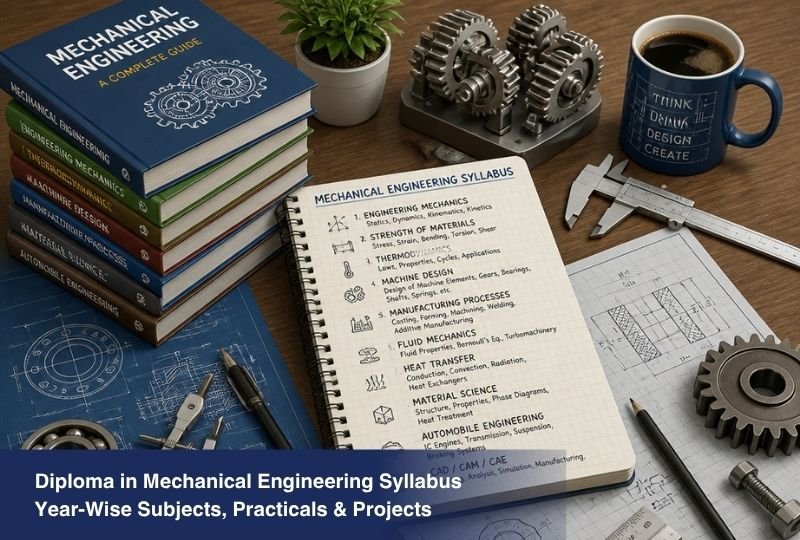
The diploma in mechanical engineering syllabus spans three years, moving from foundational science and drawing to advanced manufacturing and CAD/CAM. It’s open to students who have completed 10th or 12th standard.
Picking the right course after school shapes everything that follows. Are you drawn to how machines work, how factories run, and how products are made? A diploma in mechanical engineering might be exactly where to start.
But before you enrol, you need to know what the mechanical engineering syllabus actually covers. Not the glossy brochure version. The real year-by-year breakdown.
This guide gives you the complete diploma in mechanical engineering syllabus, broken down year by year. From Engineering Drawing in the first semester to CAD/CAM in the final year, we cover every subject and every practical. And what happens after you graduate?
Overview of the Diploma in Mechanical Engineering Program
The diploma runs for three years, divided into six semesters. It’s open to students who have completed 10th standard (SSC) as well as those finishing 12th.
If you’re comparing mechanical engineering courses after 12th with a full B. Tech options, the diploma is worth a serious look. It offers a faster, more hands-on route into the industry.
The difference from a B.Tech is mainly depth and duration. B.Tech is four years and covers more theory. The diploma focuses on practical, job-ready skills and gets you into the workforce sooner. Students who want to pursue a degree later can often enter B.Tech programmes via lateral entry after the diploma. The mechanical diploma subjects span three years, from pure science to applied engineering and design.
First Year Subjects: Foundation Semester
For students searching for a diploma in mechanical engineering, the subjects list for the 1st year, the curriculum is generally consistent across most AICTE-affiliated institutions.
The first year focuses on building a strong foundation in engineering fundamentals that support more specialised mechanical engineering subjects in later semesters.
At Sigma University, the diploma in mechanical engineering programme covers:
- Engineering Mathematics
- Engineering Physics and Chemistry
- Engineering Drawing
- Workshop Practice
- Basic Electrical and Electronics Engineering
These mechanical diploma subjects 1st year form the base on which all second- and third-year concepts are built. Engineering Drawing, in particular, is non-negotiable.
It’s the language every mechanical engineer uses on the job. The diploma 1st year mechanical subjects are designed to build analytical thinking alongside hands-on workshop skills. You won’t just study theory.
Second Year Subjects: Core Mechanical Concepts
By the second year, the curriculum moves into the heart of the discipline. This is where students start to feel like engineers.
Core second-year subjects typically include:
- Thermodynamics
- Fluid Mechanics
- Manufacturing Technology
- Strength of Materials
- Theory of Machines
Thermodynamics and Fluid Mechanics are the subjects students often find most challenging. But they’re also the ones that open doors in HVAC, automotive, and energy sectors.
Manufacturing Technology and Strength of Materials connect directly to production environments. If you’re aiming for a role in a factory or plant, these are your core modules.
Ready to Shape Your Future? Apply Now.
Engineering, Design, Commerce, Law, Science & more. Join a university built for the future.
Third Year Subjects: Advanced & Industry-Oriented
The third year is where the diploma in mechanical engineering syllabus shifts toward real-world application. The subjects are more specialised and closer to what you’ll do on the job.
Typical third-year subjects include:
- Computer-Aided Design and Manufacturing (CAD/CAM)
- Heat and Mass Transfer
- Metrology and Quality Control
- Industrial Management
- CNC Technology and Advanced Manufacturing
CAD/CAM is a standout. Employers actively look for diploma graduates who can use CAD software. It’s a practical skill that translates directly into job offers.
Industrial Management gives students a broader view of operations. How production lines are run, how quality is controlled, and how costs are tracked. That knowledge can help a technician move into a supervisory role much faster.
Practical Labs & Projects in the Diploma Program
The practical component of this programme isn’t an afterthought. It accounts for roughly 30–40% of the total curriculum.
Students spend time in:
- CAD and simulation labs
- Workshop bays covering fitting, welding, and machining
- Fluid and thermal engineering labs
- Measurement and metrology labs
By the final year, most students complete a design project or mini-dissertation. At Sigma University, these projects often involve real industry problems. Students leave with portfolio-ready work before they even graduate. The gap between a diploma graduate who can present a working project and one who can’t is significant. Employers notice it immediately.
Career Scope After the Diploma in Mechanical Engineering
The career opportunities in mechanical engineering after a diploma are broader than most students expect.
Common entry-level roles include:
- Draftsman
- Maintenance Technician
- Production Supervisor
- Quality Control Inspector
- CNC Operator
The salary of mechanical engineers at the entry level typically starts between ₹12,000 and ₹25,000 per month. This varies by role, location, and employer. With two to three years of experience, salaries grow considerably.
Companies recruiting mechanical engineers from diploma programmes include manufacturers, automotive firms, construction companies, and public sector units.
At Sigma University, the Career Development Cell actively connects students with 250+ recruiters across these sectors.
Graduates who want to continue studying can apply for lateral entry into B.Tech in Mechanical Engineering. They enter directly in the second year.
Diploma in Mechanical Engineering Syllabus: Start Your Journey at Sigma University
The diploma in mechanical engineering syllabus is more structured, practical, and career-focused than many students realise. Three years, six semesters, and a clear path from fundamentals to job-ready skills.
Whether you enter after 10th or 12th, the programme gives you real engineering knowledge and industry exposure. There’s a clear route into the workforce at the end of it.
At Sigma University, you’re not just completing a course. You’re building the foundation for your career through our Career Development Cell and industry-integrated labs. Our placement network has delivered a ₹20 LPA, the highest package.
Frequently Asked Questions
The syllabus covers Engineering Mathematics, Physics, Drawing, and Workshop Practice in the first year. The second year includes Thermodynamics, Fluid Mechanics, and Manufacturing Technology. The third year adds CAD/CAM, Heat Transfer, Metrology, and CNC Technology.
Entry-level roles typically pay between ₹12,000 and ₹25,000 per month. Salaries increase with experience, especially in manufacturing and automotive sectors.
Yes. Most universities offer lateral entry for diploma holders, allowing direct entry into the second year of B.Tech in Mechanical Engineering.
The programme is three years long, divided into six semesters. It is open to students completing the 10th or 12th standard.
Common roles include Draftsman, Maintenance Technician, Production Supervisor, CNC Operator, and Quality Control Inspector. Diploma holders can also continue into B.Tech via lateral entry.
Index
- Overview of the Diploma in Mechanical Engineering Program
- First Year Subjects: Foundation Semester
- Second Year Subjects: Core Mechanical Concepts
- Third Year Subjects: Advanced & Industry-Oriented
- Practical Labs & Projects in the Diploma Program
- Career Scope After the Diploma in Mechanical Engineering
- Diploma in Mechanical Engineering Syllabus: Start Your Journey at Sigma University
- Frequently Asked Questions