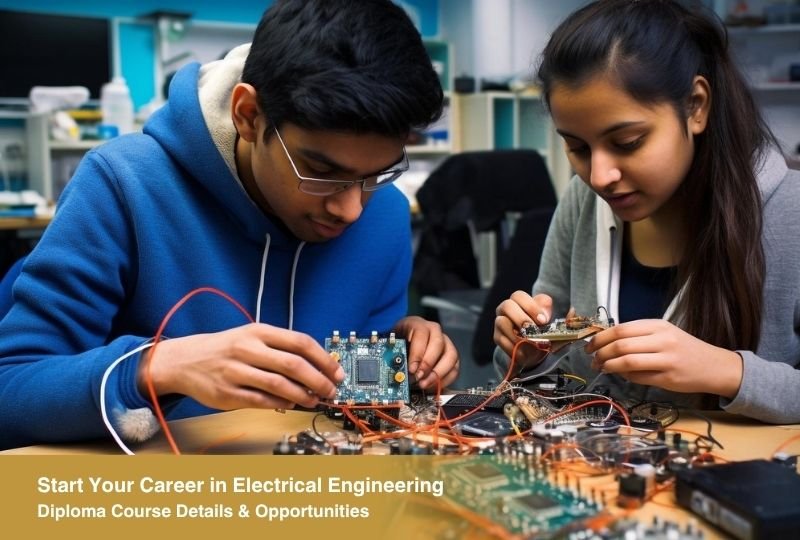
A diploma in electrical engineering offers a pathway into a demanding electrical systems and technology field with various opportunities.
It ranks among the top career-focused diploma courses in India 2025 due to its excellent placement prospects, industry relevance, and the growing demand for electrical engineers across multiple sectors.
This 3-year undergraduate course equips students with practical and theoretical skills and opens doors to various opportunities and possibilities.
What is a Diploma in Electrical Engineering?
A diploma in Electrical Engineering is a three-year undergraduate course that teaches students to apply electromagnetics, electricity, and electronics. Using various tools, this course imparts the skills required for analyzing, designing, and troubleshooting electrical systems.
Students who complete a diploma in electrical engineering can launch their careers early with a base salary of INR 2.4-4.30 lacs, making it one of the high-paying courses after 12th for science students.
The technical skills gained provide strong foundation for both immediate employment and further education through lateral entry into engineering degrees.
Subjects in Diploma in Electrical Engineering
The program encompasses a range of subjects that build a solid foundation in electrical engineering.
But here’s the catch; this isn’t just theory-heavy learning.
Each semester blends classroom concepts; with hands-on labs, workshop practice and real-world simulations.
Here’s how the learning typically unfolds across three years:
- Year 1: Basic Mathematics, Engineering Graphics, Engineering Mechanics, Engineering Workshop, Basic Communication Skills.
This is where you build your base while understanding core concepts and getting comfortable with tools and workshop practices.
- Year 2: Electrical Machines, Digital Electronics, Control Systems, Electrical Measurements + Core Lab Work.
Now things get serious. You start working with actual electrical systems, circuits and measurement techniques in lab environments.
- Year 3: Power Systems, Microprocessors, Renewable Energy, Industrial Training/Projects.
This phase is all about application; industry exposure, live projects, and preparing for real-world roles.
You will learn all the below concepts in this three-year course:
- Electrical Circuits and Machines: Study of electrical components and machinery.
- Electronics Devices and Circuits: Understanding semiconductor devices and circuit designs.
- Digital Electronics: Introduction to digital systems and binary logic.
- Control Systems: Principles of automation and control in electrical systems.
- Power Systems: Exploration of electrical power generation, transmission, and distribution.
- Electrical Drawing and CAD: Technical drawing skills and computer-aided design.
- Microprocessor and Microcontroller Applications: Programming and applications of microprocessors.
- Renewable Energy Sources: Study of alternative energy and sustainable practices.
Ready to Shape Your Future? Apply Now.
Engineering, Design, Commerce, Law, Science & more. Join a university built for the future.
Eligibility Criteria for Diploma in Electrical Engineering After 12th
To enroll in a Diploma in Electrical Engineering after 12th, candidates typically need to meet the following criteria:
Let’s clear the confusion first; most students actually start this diploma right after 10th, not 12th. But both pathways exist.
- Educational Qualification: Completion of 10th grade (SSC) or 12th grade (HSC) with a focus on science subjects (Physics, Chemistry, and Mathematics).
- After 10th: This is the most common route. You can directly enter the 1st year of the diploma.
- After 12th (Science): Some institutes allow admission, and in certain cases, lateral entry options may be available.
- Minimum Marks: A minimum aggregate score of 45-50% in qualifying examinations, though this may vary by institution.
- Entrance Examinations: Some institutions may require candidates to pass entrance exams specific to engineering diplomas.
Best Colleges for a Diploma in Electrical Engineering
Selecting a reputable institution is crucial for quality education and career prospects. Where you study shapes how industry-ready you become.
Sigma University, Vadodara stands out because it goes beyond textbook learning:
- A sprawling 26.7 lakh sq. ft. campus equipped with modern labs and well-designed workshops that support practical learning.
- Strong industry exposure; with 250+ recruiters actively participating in placement drives.
- A skill-focused curriculum that aligns closely with current industry requirements not just academic theory.
- Hands-on training, internships and project-based learning; introduced right from the early semesters.
- A team of 150+ expert faculty members; bringing both academic depth and real-world experience into the classroom.
The reality is, recruiters don’t just look for marks; they look for skills. And that’s exactly where the right college makes all the difference.
Career Scope After Electrical Diploma
Graduates with a Diploma in Electrical Engineering have a wide array of career opportunities.
You’re not limited to one path and that’s the biggest advantage here.
- Electrical Engineer: Designs and maintains electrical systems.
- Maintenance Engineer: Ensuring the operational efficiency of electrical equipment.
- Electrical Design Engineer: Developed electrical layouts and schematics.
- Project Engineer: Oversees electrical projects from conception to completion.
- Technical Supervisor: Managed technical teams and ensured compliance with standards.
You can work across industries like:
- Power generation and distribution companies
- Manufacturing and automation industries
- Construction and infrastructure projects
- Renewable energy (solar, wind)
- Government sectors like railways, electricity boards, and PSUs
And if you’re aiming for government jobs; roles in SSC JE, state electricity boards, and railways are popular options.
Job Roles and Salary Expectations
Here’s a clearer breakdown so you know what to expect:
| Experience Level | Job Role | Average Salary (₹ per annum) |
|---|---|---|
| Entry-Level (0–2 yrs) | Technician, Junior Engineer | ₹2.5 – ₹3.5 LPA |
| Mid-Level (3–5 yrs) | Design Engineer, Maintenance Engineer | ₹4 – ₹6 LPA |
| Senior-Level (5+ yrs) | Project Engineer, Supervisor | ₹6 – ₹10 LPA |
And here’s the interesting part; if you move into specialised areas like automation or renewable energy, salaries can climb faster than expected.
Ready to Shape Your Future? Apply Now.
Engineering, Design, Commerce, Law, Science & more. Join a university built for the future.
Industries Hiring Electrical Diploma Graduates
Several sectors actively seek electrical diploma graduates: Manufacturing, Construction, Automotive, Power Generation and Distribution, and Telecommunications.
Similar diverse industry opportunities exist for chemical engineering graduates who work across petrochemicals, pharmaceuticals, food processing, and renewable energy sectors with excellent scope and career growth.
- Manufacturing: The Production and maintenance of electrical equipment.
- Construction: Electrical installations in residential and commercial projects.
- Automotive: Electrical systems in vehicles.
- Power Generation and Distribution: Managing electrical grids and power plants.
- Telecommunications: Maintaining communication networks and equipment.
Further Study Options: After the Electrical Diploma Courses
Diploma holders can enhance their qualifications through:
- Bachelor of Engineering (B.E.) or Bachelor of Technology (B.Tech): Lateral entry into the second year of these programs.
This means you skip the first year and directly join the second year; saving both time and money.
- Advanced Diplomas or Certifications: Specialisations in PLC programming, industrial automation, or renewable energy.
You can also explore:
- AMIE (for engineering certification)
- Short-term industry certifications to boost employability quickly
Certificate & Specialisation Courses in Electrical Engineering
Short-term courses can provide specialized skills:
- PLC and SCADA Systems: Automation and control systems.
Learn how factories actually run; this is core to industrial automation.
- Electrical CAD: Designing electrical layouts using CAD software.
- Renewable Energy Systems: Focus on solar, wind, and other sustainable energy sources.
Solar installation skills are especially in demand right now.
- Industrial Safety: Ensuring safety standards in electrical engineering practices.
Critical for working in high-risk environments like plants and construction sites.
Think of these as “career accelerators”; they make your profile stand out instantly.
Is a Diploma in Electrical Engineering Worth It?
Short answer? Yes; but only if you use it right.
Electrical engineering is one of the most popular branches of engineering and has tremendous scope.
You can decide whether to join the job market after obtaining a Diploma in Electrical Engineering or continue your education to further upgrade your skills and knowledge.
However, here’s the real advantage; you start earning earlier than traditional degree students. That’s a big deal.
Either way, you can have a bright career in the field. Look for colleges that have focused on skill development and training opportunities. This will help you stand out from the crowd in the job market.
Contact us today for personalised guidance and more information on pursuing a Diploma in Electrical Engineering.
Because at the end of the day, your skills matter more than your marks.
Ready to Shape Your Future? Apply Now.
Engineering, Design, Commerce, Law, Science & more. Join a university built for the future.
Benefits of Pursuing a Diploma in Electrical Engineering
- High demand across industries; because almost everything around you runs on electrical systems.
- Flexible career options; whether you want to work in the private sector, government roles, or even start something of your own, this degree works.
- More affordable than full engineering degrees making it a practical choice without compromising on career potential.
- Early entry into the workforce; so you can start gaining experience (and earning) sooner.
- A strong foundation for higher studies like B.Tech; especially through lateral entry into the second year.
What this really means is simple; you’re not locking yourself into one path. You’re opening multiple doors.
Challenges Students Face in Electrical Engineering Diploma
Let’s be honest; it’s not always easy.
- Concepts like circuits and control systems can feel tough initially.
- Requires consistent practical exposure, not just theory.
- Industrial exposure depends heavily on the college you choose.
- Adapting to technical tools and software takes time.
But once you get past the basics; things start to click and that’s when it gets interesting.
FAQ
A diploma in electrical engineering opens doors to various job roles across industries. Some popular career options include:
- Electrical Engineer – Designs and maintains electrical systems.
- Maintenance Engineer – Ensuring the efficiency of electrical equipment.
- Electrical Design Engineer – Developed layouts and schematics for electrical projects.
- Project Engineer – Managed electrical projects from start to finish.
- Technical Supervisor – Leading and ensuring safety compliance.
- Power Plant Operator – Managing power distribution in plants.
- Automation Engineer – Worked with industrial automation and control systems.
Some of the top colleges offering a Diploma in Electrical & Electronics Engineering include:
- Sigma University, Gujarat – Offers a well-structured diploma program with practical training.
- Government Polytechnic Colleges (India-wide) – Known for affordable and high-quality technical education.
- Dr. T. Thimmaiah Institute of Technology, Karnataka specializes in electrical and electronics programs.
- Navodaya Institute of Technology, Karnataka offers advanced technical training with modern infrastructure.
The diploma in electrical engineering syllabus covers the following:
Core Subjects:
- Electrical Circuits and Machines
- Electronics Devices and Circuits
- Digital Electronics
- Power Systems
- Control Systems
- Microprocessor & Microcontroller Applications
Practical and Technical Training:
- Electrical Drawing and CAD
- Industrial Automation
- Renewable Energy Sources
Salary depends on factors like job role, experience, and location. On average:
- Entry-Level Jobs: ₹2.5 to ₹3.5 lakh per annum
- Mid-Level Jobs (3-5 years experience): ₹4 to ₹6 lakh per annum
- Senior-Level Jobs (5+ years experience): ₹6 to ₹10 lakh per annum
For skill enhancement, diploma holders can pursue:
- PLC and SCADA Programming – For automation and industrial control systems.
- Electrical CAD – Designing electrical layouts using CAD software.
- Renewable Energy Systems – Focus on solar, wind, and sustainable power.
- Industrial Safety & Electrical Maintenance – Ensuring safety in electrical installations.
- Advanced Power System Training – This is for specialization in power grid management.
Typically 3 years, divided into 6 semesters with practical and theoretical learning.
Yes, you can join B.Tech through lateral entry directly into second year.
The diploma in electrical engineering fees at Sigma University are designed to stay affordable, so you’re not held back by cost while still getting access to quality education and real, hands-on learning.
Index
Most Popular

High-Paying Degree Courses After 12th – Guide for Indian Students

Top 5 Career-Focused Diploma Courses in India for 2025

LLB Course: Eligibility, Admission, Top Colleges & Fees

SGPA vs CGPA Explained: Full Forms, Conversion Methods & Calculation Guide

Top 6 High-Paying Career Paths After a B.Com Degree in India
Diploma in Electrical Engineering: Scope, Salary, & Best Colleges

MCA vs MSc Computer Science: Which Is Better?

BCA Course Details: Eligibility, Fees, Syllabus, & Career Prospects

Short-Term Online Courses After 12th

Data Science vs. Data Analytics: Which Career Is Right for You?

Faculties
Related Blogs