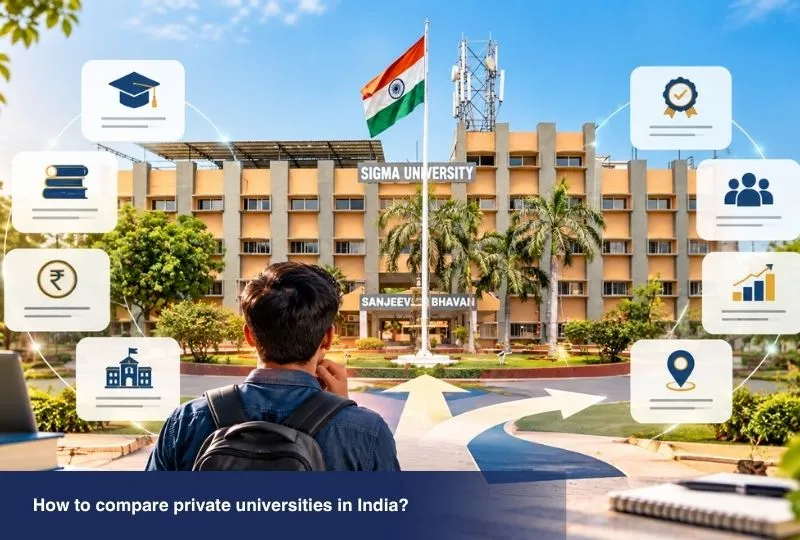
Key Insight
- To compare private universities in India, look beyond rankings and promotional claims.
- Check UGC recognition, programme quality, curriculum, faculty, placements, total fees, scholarships, infrastructure, internships, location, alumni outcomes, and industry connections.
- Shortlist three to five universities and compare the same factors using official information before making an admission decision.
Choosing a private university is a major academic and financial decision. With many institutions offering similar courses, students often find it difficult to decide which one matches their career plans, budget, and learning preferences. Knowing how to compare private universities in India can make this process easier. Instead of relying only on rankings or advertisements, students should evaluate recognition, academics, fees, placements, infrastructure, industry exposure, and long-term career value.
A 7-Point Comparison Framework
When students compare private universities in Gujarat or elsewhere in India, using the same criteria for every institution makes the decision more objective. The following framework covers the key factors to examine:
| Factor | What Students Should Compare |
|---|---|
| Recognition and accreditation | UGC recognition, applicable statutory approvals, accreditation status, and programme-specific recognition |
| Academics | Courses offered, curriculum, faculty qualifications, practical learning, electives, and specialisations |
| Placements and career support | Placement assistance, recruiters, internships, training, career services, and published placement information |
| Total cost | Tuition fees, hostel, transport, examination charges, other expenses, scholarships, and financial support |
| Facilities | Laboratories, libraries, classrooms, technology infrastructure, sports facilities, hostels, and campus amenities |
| Location and campus | Accessibility, proximity to industry, campus environment, accommodation, and living costs |
| Rankings, alumni and industry connections | Relevant rankings, alumni network, industry partnerships, internships, live projects, and employer interaction |
Students should verify recognition and regulatory information through official sources. The UGC maintains regulations and information relating to universities, including regulations concerning private universities.
Factors to Affect Private University As per Career Goal
The right university can vary considerably depending on what a student wants to do after graduation. A student planning a career in software development may prioritise coding labs, technology-focused courses, internships, and industry projects. Someone interested in management may give greater importance to business courses, corporate exposure, internships, and networking opportunities.
Budget is another important consideration. Students should calculate the complete cost of education rather than comparing tuition fees alone. Hostel, transport, books, examination fees, equipment, and other expenses can affect the total amount.
Long-term goals should also influence the decision. Students planning to pursue postgraduate education may look for strong academic foundations and research opportunities, while those seeking employment immediately after graduation may prioritise internships, placement support, industry exposure, and skill development.
Are Private Universities Better Than Government Colleges?
The question Are private universities better than government colleges? does not have one answer. Both types of institutions can offer different advantages, and the right choice depends on the student’s course, budget, admission requirements, and career goals.
| Factor | Private Universities | Government Colleges |
|---|---|---|
| Fees | Can vary significantly by institution and programme | Often lower, although this varies by institution |
| Infrastructure | Many institutions invest in modern labs and campus facilities | Facilities vary by institution and available funding |
| Academic flexibility | May offer multiple programmes, electives, and newer courses | Depends on the university and programme |
| Admissions | Institutional eligibility and admission processes vary | May involve highly competitive entrance or merit-based processes |
| Industry exposure | May include industry partnerships, internships, and live projects | Varies considerably by institution and programme |
| Placements | Depends on university, programme, student skills, and recruiter network | Varies significantly across colleges and universities |
| Career opportunities | Dependent on programme quality, skills, internships, and industry connections | Similarly dependent on institution and programme |
Ready to Shape Your Future? Apply Now.
Engineering, Design, Commerce, Law, Science & more. Join a university built for the future.
Rather than assuming one category is better, students should compare specific universities and programmes on measurable factors.
How to Compare Universities Side by Side
Start by shortlisting three to five universities that offer the course you want to study. Create a scorecard and use the same criteria for each institution.
| Factor | Private Universities | Government Colleges |
|---|---|---|
| Fees | Can vary significantly by institution and programme | Often lower, although this varies by institution |
| Infrastructure | Many institutions invest in modern labs and campus facilities | Facilities vary by institution and available funding |
| Academic flexibility | May offer multiple programmes, electives, and newer courses | Depends on the university and programme |
| Admissions | Institutional eligibility and admission processes vary | May involve highly competitive entrance or merit-based processes |
| Industry exposure | May include industry partnerships, internships, and live projects | Varies considerably by institution and programme |
| Placements | Depends on university, programme, student skills, and recruiter network | Varies significantly across colleges and universities |
| Career opportunities | Dependent on programme quality, skills, internships, and industry connections | Similarly dependent on institution and programme |
Do not rely solely on information presented in advertisements. Cross-check recognition, accreditation, programme details, fees, placement claims, and other important information through official university or regulatory sources.
Why Choose Sigma University When Comparing Private Universities in India?
Students considering a private university can evaluate Sigma University based on its academic programmes, practical learning opportunities, infrastructure, industry exposure, and career support.
Sigma University offers undergraduate and postgraduate programmes across areas including engineering and technology, computer applications, business administration, science, design, law, social work, nursing, pharmacy, physiotherapy, and hospitality. Its bachelor’s programmes emphasise practical learning, critical thinking, interdisciplinary projects, industry exposure, internships, and flexible academic pathways aligned with NEP 2020.
The university also highlights hands-on learning through laboratories, projects, internships, industry interactions, and technical training. Its engineering faculty, for example, states that students receive practical training, real project exposure, and internships as part of their learning experience.
Industry exposure is another factor students can consider. Sigma University states that its placement ecosystem includes more than 250 recruiters across programmes, while its academic offerings include internships, live projects, industrial training, and industry collaborations.
The university’s campus at Bakrol on the Ajwa–Nimeta Road covers approximately 26.7 lakh square feet and includes more than 150 classrooms and over 1,500 computers, according to its official About page.
Students should still compare the specific course, fees, eligibility, placements, faculty, and facilities relevant to their chosen programme before applying.
Conclusion
Learning how to compare private universities in India involves more than checking rankings or choosing the university with the largest number of programmes. Recognition, curriculum, faculty, practical exposure, internships, placements, fees, infrastructure, scholarships, location, and industry connections can all influence the overall value of a university.
Students should shortlist a few suitable institutions, compare the same factors side by side, verify important claims through official sources, and then select the option that aligns with their academic interests, financial situation, and career plans.
FAQ
There is no single private university that is best for every student or every course. The appropriate choice depends on the programme, academic interests, budget, location, recognition, curriculum, faculty, infrastructure, industry exposure, and career goals. Students should compare institutions using the same criteria rather than relying on a single ranking.
Students should check the latest notices and official information published by the UGC rather than relying on third-party lists or social media posts. The status of an institution can change, so the current UGC source should be used when verifying whether a university has any regulatory notice or adverse status.
Yes. UGC has regulations relating to private universities and higher education standards. The UGC publishes regulations and notifications covering areas such as university standards, academic matters, and the establishment and maintenance of standards in private universities.
There is no universal top seven because university rankings differ according to the methodology, year, discipline, and indicators used. Students should identify universities offering their preferred course and compare recognition, curriculum, fees, faculty, infrastructure, placements, internships, industry connections, and other factors relevant to their goals.

Dr. Neelima Kamjula - (Commerce & Management)
Professor & Head of DepartmentDr. Neelima Kamjula is a Professor and Dean, Faculty of Commerce & Management at Sigma University, with over 23 years of experience in higher education, academic leadership, and research.
Index
Most Popular