Key Insight
- Technical interviews assess more than your coding ability. Candidates are expected to understand data structures and algorithms, solve problems logically, explain their approach, debug code, and communicate clearly.
- The most effective way to crack technical interview questions is to build strong DSA fundamentals, practise common problem-solving patterns, take timed mock interviews, and prepare based on the role and company.
The Fastest Path to Cracking Technical Interviews
Technical interviews can feel challenging because candidates may encounter unfamiliar problems under time pressure. However, preparation becomes more manageable when you focus on the skills that interviews commonly assess rather than trying to memorise hundreds of solutions.
The first step towards cracking the tech interview is understanding the typical interview process for the role you are targeting. Depending on the organisation, the process may include an online coding assessment, technical screening, one or more technical interviews, and a final HR or managerial discussion.
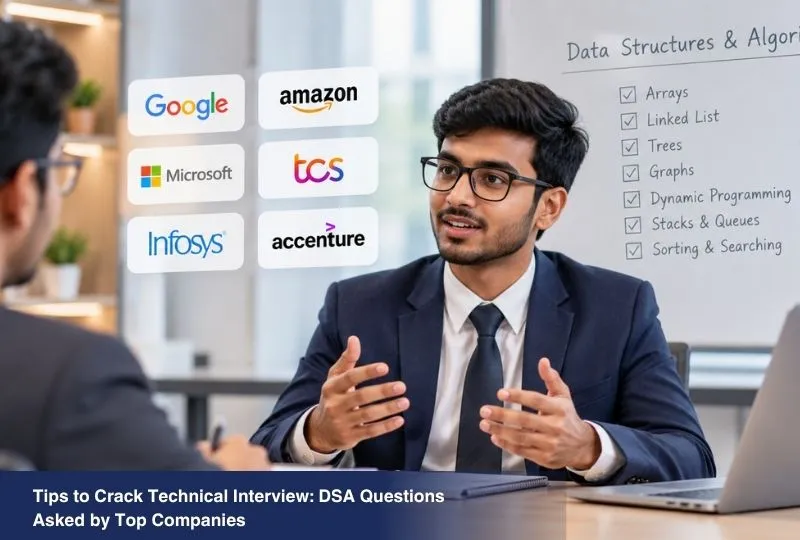
Once you understand the process, prioritise the DSA concepts that come up most often. Arrays, strings, hashing, linked lists, stacks, queues, trees, binary search, graphs, and dynamic programming form an important foundation for coding interviews.
Regular practice is equally important. Instead of simply looking at solutions, try to solve a problem independently, explain your reasoning, analyse its time and space complexity, and then review alternative approaches.
Communication is another important part of technical interviews. Even if your solution isn’t immediately correct, clearly explaining your thought process helps the interviewer understand how you approach problems.
What Top Companies Actually Test
A technical interview generally evaluates several skills, not just whether a candidate produces the correct output.
| Skill | What Interviewers May Evaluate |
|---|---|
| DSA problem-solving | Ability to select suitable data structures and algorithms |
| Coding quality | Correctness, readability, structure, and maintainability |
| Debugging | Ability to identify and fix errors systematically |
| Computer science fundamentals | Knowledge of operating systems, databases, networks, OOP, and related concepts |
| Logical thinking | Ability to break complex problems into manageable steps |
| Communication | Ability to explain assumptions, approach, and solution clearly |
| Trade-offs | Understanding of different approaches and their time and space complexity |
A strong candidate should therefore avoid treating coding as an isolated skill. Understanding why an algorithm works and when to use it is often as important as implementing it.
For example, if you are asked to find repeated elements in an array, you may consider a nested-loop approach first. You should then be able to discuss whether hashing can improve the time complexity and what additional memory that approach requires.
Ready to Shape Your Future? Apply Now.
Engineering, Design, Commerce, Law, Science & more. Join a university built for the future.
A DSA Roadmap That Matches Interview Reality
A structured DSA roadmap can help students avoid spending too much time on topics that are rarely relevant to their target roles.
Start with arrays and strings because many interview problems use these structures as a foundation. Next, develop a strong understanding of hashing, linked lists, stacks, and queues.
Once you’re comfortable with these fundamentals, move on to trees, heaps, binary search, and graphs. These topics introduce more advanced problem-solving techniques and are commonly used to test algorithmic thinking.
Study greedy algorithms, backtracking, and dynamic programming after building a solid foundation. These topics often require more practice because the main challenge is identifying the right problem-solving pattern.
A practical roadmap can look like this:
- Arrays and strings
- Hashing
- Linked lists
- Stacks and queues
- Binary search
- Trees and binary search trees
- Heaps and priority queues
- Graphs
- Greedy algorithms
- Backtracking
- Dynamic programming
Do not focus only on the number of questions solved. Try to identify recurring patterns such as two pointers, sliding window, prefix sums, binary search, recursion, breadth-first search, and depth-first search.
How to Prepare for a Technical Interview in 30 Days
A four-week plan can provide structure to your preparation.
| Week | Focus Area | Preparation Approach |
|---|---|---|
| Week 1 | Fundamentals | Revise arrays, strings, hashing, linked lists, stacks, queues, and basic complexity analysis |
| Week 2 | Pattern Recognition | Practise trees, heaps, binary search, graphs, recursion, and common DSA patterns |
| Week 3 | Timed Practice | Solve mixed-difficulty questions under interview-like time limits and identify weak areas |
| Week 4 | Revision & Mock Interviews | Take mock interviews, revise frequently used patterns, review mistakes, and prepare for target companies |
During the first week, focus on understanding concepts instead of rushing through questions. In the second week, begin recognising patterns and selecting appropriate approaches.
In the third week, introduce more timed practice. Set a time limit, solve problems without immediately checking the solution, and analyse where you lost time.
Use the final week for revision and mock interviews. Revisit problems you previously struggled with, practise explaining solutions aloud, and research the interview format of the companies you plan to apply to.
Common Mistakes in Technical Interviews That Cost Strong Candidates
Even candidates with strong technical knowledge can struggle when their interview approach is not structured.
Coding Before Understanding the Problem
Do not immediately start writing code. First clarify the requirements, inputs, outputs, constraints, and edge cases.
Poor Communication
An interviewer needs to understand your reasoning. Explain your approach before coding and communicate important decisions while solving the problem.
Ignoring Hints
If the interviewer provides a hint, use it as part of the problem-solving process rather than treating it as a negative signal. A hint may help you move towards a better approach.
Focusing Only on Difficult Problems
Solving extremely difficult questions while neglecting fundamentals can create gaps in your preparation. Build confidence with common patterns before moving to advanced problems.
Weak Computer Science Fundamentals
DSA preparation shouldn’t replace core subjects. Depending on the role, revise topics such as object-oriented programming, databases, operating systems, computer networks, and software engineering.
Resume and Interview Mismatch
Be prepared to explain every significant project, technology, internship, or achievement mentioned on your resume. Interviewers may ask why you selected a particular technology, what problem you solved, and what challenges you encountered.
Company-Wise Preparation Without Guesswork
Preparation should reflect the type of organisation and role you are targeting. Product-based companies may place greater emphasis on algorithmic problem-solving, DSA depth, coding efficiency, and technical fundamentals.
Service-based companies may use a combination of aptitude, coding, technical fundamentals, communication, and role-specific assessments. Startups can have varied requirements and may focus more heavily on practical coding, projects, adaptability, and the ability to work across technologies.
For off-campus roles, candidates should study the job description carefully and prepare based on the listed skills. Reviewing the company’s recruitment process, role requirements, commonly used technologies, and expected interview rounds can help you prepare more effectively.
Instead of assuming that every company asks the same questions, use company-specific preparation after building a common DSA foundation.
Interview Day Checklist
Before appearing for a technical interview, review the following:
- Revise frequently used DSA patterns.
- Review time and space complexity.
- Practise explaining your solution before coding.
- Revisit common mistakes from previous practice sessions.
- Prepare to discuss every major project on your resume.
- Review core computer science fundamentals relevant to the role.
- Check your coding environment and internet connection for online interviews.
- Keep your resume and other required documents ready.
- Read the job description once again.
- Get adequate rest instead of trying to cram for hours.
During the interview, understand the problem, clarify assumptions, explain your approach, write clean code, test edge cases, and discuss your solution’s complexity.
Why Choose Sigma University for Building Technical and Placement Skills?
Sigma University provides students with an academic environment focused on developing technical knowledge and career-oriented skills. For students pursuing computer science and related programmes, classroom learning can be complemented by practical projects, programming activities, internships, and industry exposure.
Students can build their programming and problem-solving abilities through practical learning and project work. Exposure to industry-oriented technologies can also help students understand how classroom concepts apply to real-world technology environments.
Placement preparation can further support students as they transition from academic life to professional opportunities. Technical training, communication development, interview preparation, internships, and career guidance can help students approach recruitment processes with greater confidence.
For students interested in software development and technology careers, developing a combination of programming fundamentals, DSA knowledge, project experience, communication skills, and practical exposure can provide a strong foundation for technical recruitment.
Conclusion
There is no shortcut to cracking technical interviews successfully. The most effective preparation combines strong fundamentals, consistent DSA practice, pattern recognition, timed problem-solving, mock interviews, and clear communication.
Start with commonly tested topics instead of trying to solve every available problem. Learn from mistakes, understand different approaches, and practise explaining your reasoning. At the same time, keep your resume aligned with your actual skills and be ready to discuss your projects in detail.
Whether you are preparing for a product company, service-based organisation, startup, or off-campus opportunity, a structured approach can make technical interview preparation more focused and manageable.
FAQ
To crack a DSA interview, build strong fundamentals in arrays, strings, hashing, linked lists, trees, graphs, and other core topics. Practise common problem-solving patterns, analyse time and space complexity, solve problems under time limits, and take mock interviews. You should also practise explaining your approach clearly before writing code.
The 30-60-90 rule is commonly used to structure goals for the first 30, 60, and 90 days in a new role. During interviews, candidates may use this framework to demonstrate how they would approach learning, contributing, and taking greater responsibility after joining an organisation.
The 80/20 rule, or Pareto principle, is sometimes applied to interview preparation to suggest focusing on the smaller set of topics and problem patterns that are most relevant to the target role. It is a preparation strategy, not a universal interview rule.
The five Cs are commonly described as communication, confidence, clarity, competence, and composure. Different organisations and career resources may use slightly different versions of the framework, so candidates should treat it as a general interview preparation model rather than a fixed industry standard.
Begin by understanding the interview format and job requirements. Revise DSA and core computer science concepts, practise common coding patterns, solve problems under time constraints, review your projects and resume, and participate in mock interviews. Focus on explaining your reasoning, not just reaching the correct solution.
No fixed number guarantees interview readiness. Instead of targeting a specific count, focus on understanding common DSA patterns and solving representative problems across different difficulty levels. Reviewing mistakes and solving variations of familiar problems is more useful than simply increasing the number of questions you complete.

Dr. Neelima Kamjula - (Commerce & Management)
Professor & Head of DepartmentDr. Neelima Kamjula is a Professor and Dean, Faculty of Commerce & Management at Sigma University, with over 23 years of experience in higher education, academic leadership, and research.
Index
- The Fastest Path to Cracking Technical Interviews
- What Top Companies Actually Test
- A DSA Roadmap That Matches Interview Reality
- How to Prepare for a Technical Interview in 30 Days
- Common Mistakes in Technical Interviews That Cost Strong Candidates
- Company-Wise Preparation Without Guesswork
- Interview Day Checklist
- Why Choose Sigma University for Building Technical and Placement Skills?
- Conclusion
- FAQ
Most Popular