The pharmaceutical industry is growing in India due to the innovation in healthcare, an increase in regulatory standards, and pharmaceutical demand around the world.
Individuals who have a Bachelor of Pharmacy (B.Pharm) can become a part of careers in terms of drug development, hospital pharmacy, clinical research, and regulation. Preparing in advance to join B. Pharm courses in 2025, eligibility criteria, entrance examination, and cut-offs make the student ready.
Overview of B.Pharm Course in India
What is a Bachelor of Pharmacy (B.Pharm)?
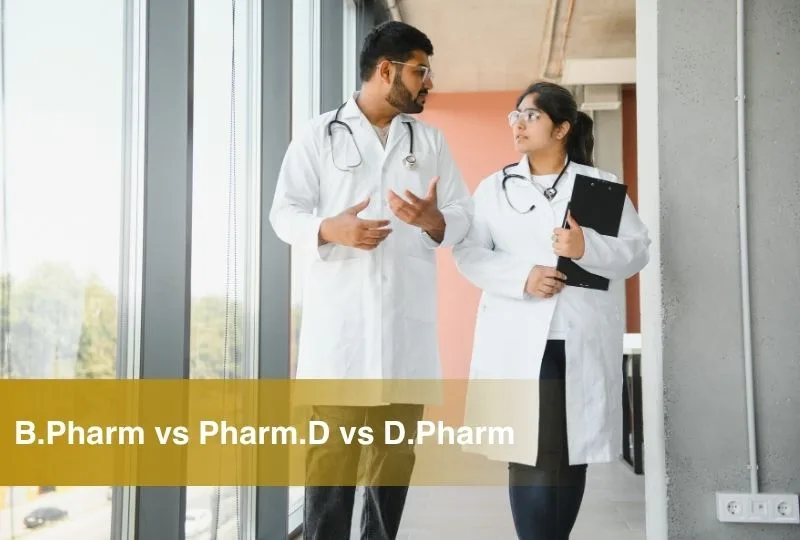
It is an eight-semester, four-year undergraduate program known as B.Pharm. It encompasses pharmacology, pharmaceutics, pharmaceutical chemistry, pharmacognosy, clinical pharmacy, and regulatory affairs. Students comparing pathways should also check B.Pharm vs Pharm.D vs D.Pharm to choose the most suitable pharmacy route. Pharmacists are professionals in healthcare facilities, drug manufacturing and production quality, and research centers.
Why Choose B.Pharm After 12th?
The completion opens up employment opportunities within both the public and the private sectors, such as hospital pharmacies and pharmaceutical companies, government health services, clinical research organisations, as well as regulatory bodies.
The graduates can also opt to get higher education, such as M.Pharm, Clinical Research, or MBA in Pharma Management.
Eligibility Criteria for B.Pharm Admission 2025
Educational Qualification
Candidates are required to have passed 10+2 with Physics and Chemistry along with either Mathematics or Biology. The majority of institutes require a minimum aggregate of 45–60 percent, depending on category and college. Students comparing course options can also review different pharmacy courses after 12th before finalising their choice.
Students still weighing their stream options may also want to explore the best UG courses to pursue after 12th to understand how B.Pharm compares with other undergraduate programs in terms of scope and employability.
Age Limit, Board-Specific Conditions (if any)
Most colleges do not restrict their age limit, although state-owned institutions can have higher age limits or domicile-residency conditions. There is relaxation of marks in the reserved category (SC/ST/OBC).
Documents Required at the Time of Application
Students should prepare photocopies and originals for:
- Class 10 and 12 mark sheets
- Passport-size photographs
- Valid ID proof (Aadhaar/Voter ID/Passport)
- Domicile/residence certificate
- Category or disability certificate, if applicable
B.Pharm Admission Process 2025
Entrance-Based Admissions
Major admissions hinge on exam scores, such as:
- NEET (optional for some universities like Jamia Hamdard)
- MHT‑CET (Maharashtra)
- GUJCET (Gujarat)
- WBJEE (West Bengal)
- OJEE (Odisha)
Admission is merit‑based via counseling after results are published.
Direct Admission (Merit-Based)
There are also some private colleges in which admission is made directly based on Class 12 performance without considering the entrance examination scores.
They tend to be more expensive (in terms of tuition fees), offer more management quota places, and have a quicker process for admission.
Application Procedure
- Online registration on college or state portals
- Enter personal and academic details
- Upload the required documents
- Pay application or counselling fees
- Track status and complete verification
Top Entrance Exams for B.Pharm Admission
National and State-Level Exams
- NEET: Primarily for MBBS/BDS, but accepted by some private B.Pharm colleges.
- MHT‑CET: Maharashtra’s state test, typically held in May.
- GUJCET: Gujarat admission gateway.
- WBJEE: West Bengal’s entrance for engineering and pharmacy.
- OJEE: Odisha Joint Entrance Exam, including B.Pharm.
Exam Pattern and Syllabus Brief
The multiple-choice questions always exist in Physics, Chemistry, Biology, and Mathematics on all exams. In NEET, Biology is stressed, while state CETs, in some cases, do cue on state board syllabi.
Understanding the exam pattern early gives you a real edge — find out how to prepare for B.Pharm entrance exams with subject-wise tips, recommended books, and mock test strategies.
Cut-Offs for B.Pharm Colleges
Government Colleges
Typical cut‑offs range by exam and state:
- In Maharashtra’s official colleges via MHT‑CET, the eligible percentiles align around the 85–95 percentile for the general category.
- Gujarat’s GUJCET for top public colleges has cut‑offs equivalent to the 85–90 percentile.
State‑level seat allotment is strictly merit‑based.
Private Colleges
The cut-off or direct entry channels of admission are lower in the private institutes. Cut-offs change but are usually between 60% and 75 per cent in 12th or CET per centile.
B.Pharm Fees and Course Duration
Course Duration
The B.Pharm program is based on four years of study that are divided into eight semesters. An internship and a project report in the final year are required in many colleges.
Fee Structure
- Government colleges: ₹10,000–₹60,000 per year
- Private colleges: ₹1 Lakh – ₹2.5 Lakhs per year, depending on infrastructure and reputation
- Additional expenses: include books, lab coats, clinical rotation fees, and exam charges
Career Opportunities After B.Pharm
Government and private sectors offer roles such as:
- Pharmacist in retail or hospital pharmacies
- Drug Inspector or Quality Assurance Officer
- Clinical Research Associate
- Regulatory Affairs Specialist
Higher education options include M.Pharm specialisations, MBA in Pharmaceutical Management, or careers in research and academia.
How to Choose the Right College
Look for:
- PCI and AICTE approval (mandatory)
- Strong placement records and internship tie-ups
- Campus infrastructure, such as labs and hospital attachments
- Course fee versus expected ROI and placement packages
- State-level or national counselling support if entrance-based
FAQs About B.Pharm Admissions 2025
It is not a must that a B.Pharm aspirant take NEET. The state-level entrance examinations, such as MHT-CET, GUJCET, among others, scores are accepted by most of the colleges, or they are given admission directly on a merit basis, depending on the marks of science subjects in Class 12.
Go to the official websites of universities or state counseling authorities. Register, complete the application form, attach necessary documents, pay the application fee, and check the admission/counseling status by means of your logins and passwords.
Cut-offs are state and time-dependent. The general seats in the government colleges require the candidate to fall in the 85th to 95th percentile in the entrance examinations, such as MHT-CET, GUJCET, or WBJEE.
Yes, there are some private colleges that provide direct entry in merit, which depends on class 12 marks without any entrance examination. A minimum of 45% 50 % in PCB/PCM is typical. Most of the government colleges do not admit under direct admission.
B.Pharm provides specialization in medicines, resulting in careers in health, drug manufacturing, and the government. It is a solid choice among students pursuing applied sciences, and it also has a better chance of immediate employment as compared to general B.Sc. courses.
Generally, admission into B. Pharm starts in April-May 2025 when applications in the form are rolled out to take the state-level exams and apply to the universities.
The merit-based admissions and counseling are done, usually, after 12th standard results have been announced. It depends on the state where the timelines differ.
Index
- Overview of B.Pharm Course in India
- Eligibility Criteria for B.Pharm Admission 2025
- B.Pharm Admission Process 2025
- Top Entrance Exams for B.Pharm Admission
- Cut-Offs for B.Pharm Colleges
- Cut-Offs for B.Pharm Colleges
- Career Opportunities After B.Pharm
- How to Choose the Right College
- FAQs About B.Pharm Admissions 2025
Most Popular